Leaving Perth 17 th NOV
Leaving Dawesville, we said our goodbyes to Mick and Di, it was so nice to spend time with them again. Amazing how we met them in Croatia in 2015 and now they are great friends although ones we can’t see often with both us living on opposite sides of the country. A suggestion was made for north Spain in a year or two….maybe.
We headed south east into the wheat belt area of WA for Katanning, a small country town where Johns uncle was buried. He wanted to check on his grave and see if the cross put up by his cousin, Bruce Cook, last year was still present and not requiring any repairs. All was okay.
The night was spent in a free camp, a lions park in the middle of katanning.
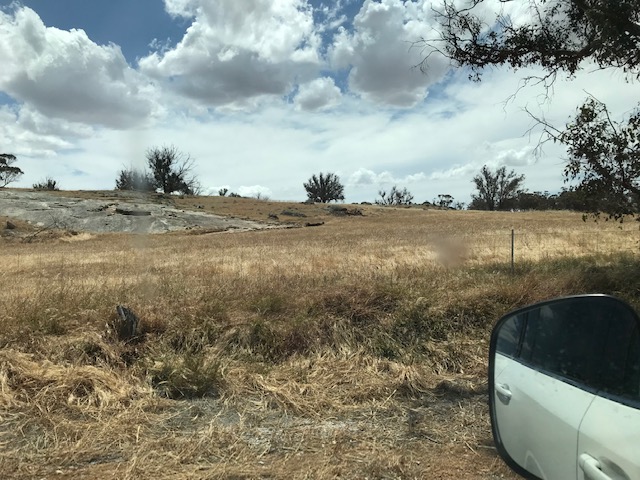
The scenery on the way through the wheat belt was dry and lots of farmland where a lot of harvesting was going on. Bales of hay where a common site and dry open spaces with granite formations in other areas.


The next day we drove to Wave Rock , in a north east direction and via a series of small but interesting towns.
Dumbleyung, the town where the blue bird speed boat replica lives. Donald Campbell set the world water speed record here in 1967 on Dumbleyung lake the speed reached was 442 kms / hr and he also set the land speed record that year on Lake Eyre with a speed of 404 kms per hour. He lost his life 3 years later in another speed record attempt. Land & water speed record attempts have an 85% fatality rate, Donald Campbell just pushed his luck to far.


Above is a sign for the “dunny”, we found amusing.
Kulin, another small town where tin horse statues were along the roadsides and very surprisingly for a remote bush town it also had a huge waterslide and pool. Most of these little towns amazed us, all having pools and huge park areas full of child’s play equipment and all with free overnight stops for caravans.


The second picture above shows some local fauna, the bush was a real silver coloured leaf with a red bottlebrush, it was so pretty.
We arrived in Hyden and the caravan park was right in front of Hyden rock and the “wave rock” formation, a 1 minute walk to see wave rock.
We wandered around the small township and took photographs of the tin statues that portray the lives of local people and their occupations, it was well done.
As usual in these outback areas the flies were everywhere and drove us mad.


We drove out to Magic lake which has 9 times the amount of salt that is in the sea, so very buoyant. We return later for sunset photograghs but the cloud cover didn’t allow for the best photos.


Above was debbie saying again to John NO stop talking my photo.
The next day we walked over to look at wave rock, a fantastic site, the shape and colours of the rock amazing. It certainly looks like a wave. The wave is just part of Hyden rock which was huge extending down to the Hippos Yawn, which had separated from the main rock formation and shaped by the weather and erosin.


We walked across the top of Hyden rock, which gave a great view over Magic lake and surrounding area, viewed the dam, then walked the 1.3 km track to Hippo yawn.


After morning coffee we walked to the breakers, Boulder formations dropped overtime from the main rock. It was so handy being right next to the rock formations and just popping back to the van for morning tea and lunch.


After lunch went to see Mulka’s cave with its Aboriginal art. Here we were meant to see over 400 hundred hands coloured in the cave but we could only make out a couple.


Then walked the track to the Gnunna holes. These are water holes in the rock formations and some are very deep. It is meant to be drinkable but didn’t look very nice.


The flies at times have been horrid, constantly thousands trying to get up your nose, under your glasses and they kept getting in Johns ears and buzzing. So we decided to buy some fly nets at wave rock that go over your hat and cover your face. They made walking around sight seeing at these attractions much more pleasant even if we did look a bit silly.
Left Wave rock on the 20 th Nov via
Narembeen a typical wheat belt town, where we visited the Grain discovery centre, the centre describing the farming method for the production of grain from old to new methods. For a small town it appeared to have a lot of community spirit, with great facilities for the locals including a big public pool and large bowling club and tennis courts.


Then along the great eastern hwy having photo stops at the
Rabbit proof fence, the longest fence in the world.


A farm fence we went past was covered in hundreds of old shoes. Apparently someone found a shoe, and left it in on a fence post in case someone came back looking for it and now it has become an tradition to leave a shoe on the fence. Makes for a novel idea and certainly a good photo and a change from the dry countryside.


Over night was at a free stop at Coolgardie, the first area to have gold discovered in the late 1800,s. A chat with the lady at the pub gave us an insight into the town’s history, which we were going to read about at the local museum the next morning , but alas it was closed for that day only.
We enjoyed another free stop here out side an old railway and John found the same train there that he and some mates had taken photos on in 1980. Johns friend on the right of the 1980 photo Phil died 4 years later in a motor bike accident, he had just turned 23. He was a great mate and a young life cut far too short.
1980
2018
the town also had a open air museum of old farm machinery and classic old buildings, this is a town we’d like to return to when the museum is open.


Next stop Kalgoorlie and we are now in the area known as the gold fields.
We stayed here four nights but only saw a few sites as Johns has put his back out and is so bad he can barely stand or walk. He saw a recommended acupunctist but treatment failed to help, so we will face the trip back and seek treatment at home. John tends to put his back out every six months or so, but this time it is quite severe. Debbie now has to empty the chemical toilet waste tank from the caravan because John can not lift it, something she has always avoided up until now as she says that it is a boy job, poor Debbie!!
Before johns back got chronic we managed to see a few things with difficulty.
We still managed to visit the lookout of the super pit, a huge gold mine just on the very edge of town, it is the second largest working gold mine in the southern hemisphere.


Next point of interest was The old loop train museum which tells the story of train line made to transport residents between the gold mine in these areas and from Kalgoorlie To Boulder. It was the busiest railway system in Australia at the time. This rail line was abandoned when a tram line was introduced.


Next, the Boulder town hall that has a old painted stage curtain called the Goatcher curtain and has hung here since the opening of the town hall in 1908. It was amazing.

The towns of Kalgoorlie and Boulder have joined now both grown enormously in size. Kalgoorlie used to be known as the rich side and Boulder the poor side, though these days that has dramatically changed.
The old building fronts and pubs in the area making this old town very charming and the painted murals interesting and adding colour to the town. There is so much more to see and do here in Kalgoorie, we will return another time. Tomorrow the 25 Nov , we continue our early return journey home and get a diagnosis and treatment for John . John’s only relief is sitting so hopefully we can manage the drive home and find places where we don’t have to unhitch the car from the van.


